The Vending Machine Patriot
A psychological, historical, and thoroughly sarcastic analysis of public behaviour of Kapoor who became everything to everyone and nothing at all.

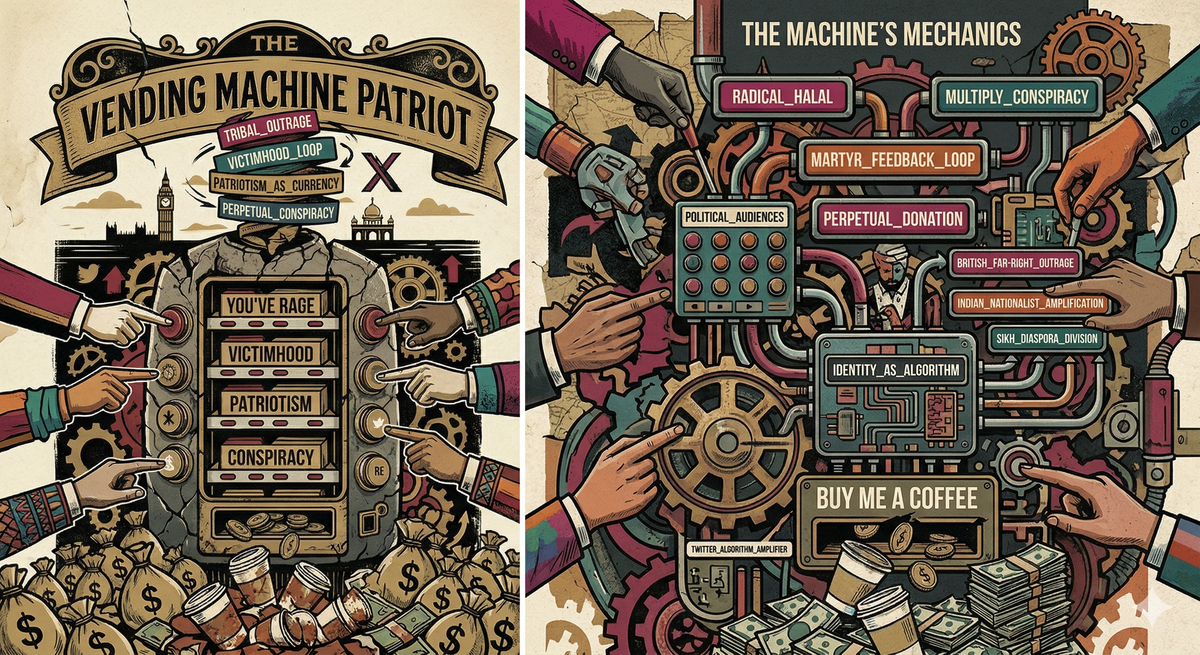
A vending machine doesn't care who presses its buttons. Press A3, you get outrage. Press B7, you get martyrdom. Press C2, you get patriotism extra strong, with Indian nationalist flavouring. The machine is always on. The machine is always hungry. And the machine always has a donation link in the bio.
The Bio, The Brand, The Bottom Line
Any examination of Harman Singh Kapoor's public profile reasonably begins where he himself chose to begin it: his X biography. As of the time of writing, it reads: "OWNER OF RANGREZ NON HALAL INDIAN RESTAURANT. FREEDOM IS NOT FREE." Beneath that statement sits a link to his Buy Me a Coffee page, a platform that allows followers to make small financial contributions directly to a creator.
The juxtaposition is notable and worth examining on its own terms. The phrase "Freedom is not free" is a well-worn expression of political sacrifice. Its placement immediately above a personal monetisation link is, at minimum, an interesting editorial choice and one that offers a useful lens through which to understand Mr Kapoor's wider online operation.
A review of his publicly available content suggests that Mr Kapoor's primary activity is not restaurateuring but content creation. His output spans topics including Sikh identity, British national culture, criticism of Islam, allegations concerning Pakistani grooming gangs, and claims relating to Khalistani political movements. His content has also drawn an audience among Indian nationalist commentators, his work has been referenced approvingly by outlets including OpIndia, a publication with a documented record of Hindu nationalist editorial positioning.
What is observable and what is a matter of public record rather than interpretation is that Mr Kapoor's content operation appears to serve multiple, ideologically distinct audiences simultaneously. Whether that reflects a coherent worldview, a responsive content strategy, or some combination of both is a question this publication puts to Mr Kapoor directly, Only He knows his own truth.
What can be said, based solely on publicly available material, is that Mr Kapoor has constructed a platform that monetises outrage across several overlapping communities and that the communities in question do not all share the same interests, or in some cases, the same facts.
The Asylum Seeker Who Hates Asylum Seekers
Here is the foundational contradiction, the one from which all others flow like tributaries from a polluted spring.
The Gatekeeper Paradox: When the Welcomed Become the Unwelcoming
There is something worth examining in the story of a man who, by his own account, fled a radicalised country and found safety in Britain. The kind of story that, in its early chapters, reads as a testament to what open societies can offer those fleeing violence and instability.
What makes this case publicly notable is not the journey. It is what reportedly came later.
Social media posts attributed to the individual in question included the sentiment that immigrants who had come to Britain "to change this beautiful country can fuck off" language that has since attracted significant public attention and criticism. In a separate post, he is reported to have declared Britain "a Christian land." The individual making these declarations calls himself, a Sikh man (though there are serious questions within the Sikh community on this claim) with roots in Afghanistan.
These are matters of public record and public commentary. No allegation of criminality is made here. The observations that follow are analytical, not accusatory.
Psychologists and sociologists have long documented a phenomenon sometimes described through Henri Tajfel and John Turner's social identity theory, individuals who have successfully transitioned into a new social group can, in certain circumstances, perform strong rejection of others seeking similar inclusion a behaviour some researchers suggest functions as a means of consolidating one's own sense of belonging within that group. Whether this framework applies to any specific individual is a matter for readers to assess.
What is observable, and fair to note, is the internal tension in the public statements as reported, a man who benefited from Britain's asylum system publicly positioning himself as an arbiter of who deserves a place in it. A man who arrived from outside Britain's Christian majority tradition declaring the nation's religious identity on behalf of its population.
These contradictions have been noted widely. His supporters argue he represents precisely what integration looks like someone who has adopted and defends British values with conviction. His critics contend the specific language used is exclusionary and, given his own biography, strikingly inconsistent.
Both readings are available to reasonable people. What is harder to dispute is that the statements exist, that they were made publicly, and that the biography behind them is what it is.
The rest, as they say, is a matter of public interest.
Psychological note: Research on motivated reasoning (Kunda, 1990) shows that the mind will construct whatever justification is needed to reach a pre-determined conclusion. In Kapoor's case, the conclusion appears to be: "I belong here and certain others do not." The reasoning Christian land, British values, anti-Islamisation shifts freely to serve that conclusion. The conclusion never shifts.
Too Extreme For Tommy Robinson
(A Sentence That Should Come With a Warning Label)
Baaz News, in its coverage of the 2024 UK far-right riots, described Kapoor as Tommy Robinson's "newest standout cheerleader" a characterisation drawn from his publicly visible activity at the time. According to that coverage and other contemporaneous reporting, Kapoor participated in demonstrations associated with Robinson's movement and maintained a visible online presence in support of it.
What happened next is a matter of public record.
Kapoor was subsequently removed from Robinson's organisation. The reasons cited were stated publicly by Robinson himself, and can be reported on that basis. Robinson alleged that Kapoor had posted images online involving Robinson's then-15-year-old son during a period when Robinson was imprisoned, conduct Robinson stated had frightened the boy. Robinson's team additionally cited Kapoor's removal as being connected to comments allegedly made toward Sikh communities, which Robinson's organisation deemed insulting.
Kapoor's response to these allegations, if any, was not captured in the public statements reviewed for this piece.
To be clear: Tommy Robinson the man with a criminal conviction record, the co-founder of the English Defence League drew a line. And Harman Singh Kapoor was on the wrong side of it. This is not editorialising. This is a documented sequence of public events, stated by the parties involved, on publicly accessible platforms.
The far-right media ecosystem, observers noted, appeared unlikely to embrace him as a peer. Baaz News reported that he "received a torrent of racism online despite his clear allegiances to Robinson" suggesting that elements of the very movement he had publicly aligned himself with directed hostility toward him. Whether he was aware of this dynamic at the time, or chose not to address it publicly, remains unclear. What is documented is that his formal removal from the movement became a matter of public record.
Psychologists and researchers who study political extremism have written extensively on what some describe as identity-threat response a pattern observed when an individual whose sense of self is closely tied to group membership faces rejection from that group. Academics in the field have noted that a common behavioural response can include intensified rhetoric, more extreme positioning, or a shift toward new platforms and audiences. Whether any such framework applies to this individual's subsequent behaviour is a matter of interpretation for the reader.
What is on the public record is that following his expulsion, he announced a pivot to full-time activism. The significance of that decision and what it signals about his trajectory is something commentators and observers continue to assess.
The Restaurant: A Stage, Not a Kitchen
A Legal Note on Method Before We Begin
What follows is based on publicly available information, including social media posts made by Harman Singh Kapoor in his own name, footage circulated in the public domain, and statements he made on the record. Opinion is clearly identified as such. Nothing here asserts facts not already in the public record.
Fair Comment and Why That Matters
It is worth beginning where fairness demands we begin.
Harman Singh Kapoor's decision not to serve halal meat at his restaurant, Rangrez, is a lawful business choice. Many Sikhs observe the tradition of jhatka slaughter and hold sincere religious objections to halal practices. Mr Kapoor is entirely within his legal rights to operate his business according to those principles. That is not in dispute here, and nothing that follows should be read as suggesting otherwise.
What is open to examination and what this piece examines is the manner in which he chose to exercise that right, and the reasonable questions that manner invites.
What the Public Record Shows
On the morning of 14 March 2026, Mr Kapoor published a social media post calling what he described as a "Non Halal meetup" at Rangrez, urging supporters to attend at 2pm and, according to posts widely circulated and reported on at the time, encouraging attendees to bring recording equipment to, in his words, "help us record any troublemakers."
These are his own stated words, published publicly.
Video footage subsequently shared across multiple platforms appeared to show Mr Kapoor outside the restaurant during a confrontation with a crowd, during which he could be heard shouting "Kill me" as police worked to manage the situation. He was arrested. He was released without charge.
Following his release, Mr Kapoor made a public statement. In it, he said: "All I did was protect my family, yet I was the one arrested. Instead of protecting us, the police targeted my religion, my Sikh faith and my beliefs."
Separately, in a post made approximately one week before the incident again publicly, in his own name Mr Kapoor referred to Muslim patrons who had objected to his non-halal policy as "inbreds." In an earlier post, also public, he characterised halal slaughter as something that, in his view, "promotes terrorism."
These statements are a matter of public record. Readers may form their own view of them.
Fair Comment on the Pattern of Conduct
What follows is the opinion of this writer, offered as fair comment on a matter of public interest.
A business owner's right to run their premises according to their faith is not the same thing as a right to be beyond scrutiny for the way they conduct themselves in public. Mr Kapoor did not simply open his restaurant and serve lunch. He issued a public call to attend, requested that supporters bring cameras in anticipation of conflict, and made a series of inflammatory public statements about a religious group in the days surrounding the incident.
In this writer's view, the cumulative picture is one of a man with considerable media awareness, who understood that a camera-ready confrontation framed as religious persecution would generate significant online attention. Whether that awareness was strategic or instinctive is something only Mr Kapoor could say.
What is observable is the result, significant media coverage, a donation link accessible via his public profile, and a series of restaurant closure announcements that were subsequently reversed each generating a fresh wave of engagement.
None of that is unlawful. It is, however, in this writer's opinion, worth noting.
The Wider Context
Research in psychology and media studies has long documented that content framed around identity threat and moral outrage generates higher engagement than neutral content. This is not a controversial claim it is a well-evidenced feature of how online platforms function. Content creators across the political spectrum have learned to work with it.
It is this writer's opinion that Mr Kapoor's conduct during this period reflects an understanding of those dynamics, whether consciously applied or not. That opinion is offered not as accusation but as observation one that readers are free to reject.
A Final Note
Mr Kapoor has not been convicted of any offence. He was released without charge. His right to operate a non-halal restaurant, to hold religious beliefs, and to speak publicly about them is not questioned here.
What is questioned fairly, and on the public record is whether the manner in which he chose to exercise those rights served the community, or served the algorithm.
Those are not always the same thing.
The British Patriot With Very Foreign Backers
Questions of Influence: Who Is Amplifying Harman Singh Kapoor, and Why?
Harman Singh Kapoor has publicly presented himself as a British patriot. But a review of the media ecosystem amplifying his content raises questions that merit scrutiny.
Among the outlets that have repeatedly featured or promoted his story is OpIndia, an Indian digital publication which Reporters Without Borders has described in published reports as "closely aligned with the supremacist Hindu nationalist ideology Hindutva." According to reporting reviewed for this piece, retired Indian Foreign Service officers have praised Kapoor on the social media platform X, and several Indian nationalist media outlets covered his arrest with what observers characterised as notable sympathy.
Baaz News, a publication covering Sikh affairs, has reported what it describes as a broader pattern. In its own words, "Indian accounts have been amplifying and pushing anti-Sikh rhetoric online, using their IT Cells to feed impressions and clicks to far-right accounts." Baaz News further reported that Kapoor's role in that ecosystem is, in its characterisation, "no secret," describing him as "a known Indian nationalist online agitator who previously worked to target Sikh sentiments." Kapoor has not, to this publication's knowledge, publicly responded to those characterisations.
Separately, the Institute for Strategic Dialogue, a London-based research organisation focused on disinformation and extremism has published findings documenting what it characterises as a strategic alliance between elements of the Indian nationalist media ecosystem and parts of the British far-right. According to ISD's analysis, that relationship appears built on a shared hostility toward Islam rather than common political values. Professor Christophe Jaffrelot of King's College London, a scholar of Hindu nationalism, has been quoted describing it as an arrangement that "might seem like a strange alliance but it is strategic."
Taken together, these documented observations raise a legitimate question of public interest, to what extent does Kapoor's content whatever his personal intentions function within, and benefit from, a foreign media ecosystem with its own political objectives?
Scholars of foreign influence operations have written about what they term "soft assets" individuals in one country who genuinely believe themselves to be acting as patriots, while their output aligns with, and is amplified by, the interests of a foreign ideological movement. The label carries no implication of conspiracy or knowing participation. It describes, in the academic literature, a structural relationship rather than a deliberate one.
Whether that framework applies to Kapoor is a matter for informed public debate. What the available evidence does establish is this, a man who identifies publicly as a British patriot is a favoured figure in Indian nationalist media, a man who has positioned himself in relation to British Sikh communities is amplified by outlets that, according to several Sikh journalists and publications, work against Sikh interests, and a man who wraps his public identity in British iconography draws his loudest international support from commentators based outside the United Kingdom.
These are documented facts. The conclusions readers draw from them are their own.
Note: OpIndia was found by RSF to have published at least 314 articles specifically targeting journalists, with coordinated harassment campaigns following many of them. This is the outlet that treats Harman Singh Kapoor as a hero. The company a man keeps is always instructive.
The Contradiction Engine: A Public Record
The following is not editorial. It is a documented chronology of his public positions, placed side by side. The reader may draw their own conclusions. The reader will find it very easy to do so.
What He Said Vs What Also Happened
- "I came to the UK as an asylum seeker… We didn't come to change Britain."Follows with: "immigrants who came in here to change this beautiful country can fuck off."
- Presents himself as a devout Sikh defending his faith, Booted from Tommy Robinson's organisation for allegedly insulting Sikh communities
- Claims Britain is "a Christian land" and Is not Christian. Is not British-born. Arrived from Afghanistan as an asylum seeker
- Positions himself as a proud British patriot, Primary amplification comes from Indian nationalist media and retired Indian Foreign Service officers
- Presents as defender of Sikh identity, Described by Baaz News as "a known Indian nationalist online agitator who previously worked to target Sikh sentiments"
- Announced Rangrez restaurant was closing due to harassment, Then said it was staying open due to local support. Then closed it. Then discussed reopening
- Shared a video about Israel's drones in Gaza captioned "See the Miracle", Community notes on X flagged the video as being from Jordan in 2020, showing people faking deaths during COVID curfew. Unrelated to Israel or Gaza entirely
- Tommy Robinson's standout cheerleader, marching and posting alongside him, Expelled by Robinson's team. The far-right still directed racism at him throughout his period of allegiance
All entries above sourced from documented public posts, X community notes, Baaz News, Reform Party UK Exposed, and statements by parties directly involved.
The "Sikh" Label: Costume or Conviction?
This section requires the most care, and is offered with the most precision.
Questions of religious authenticity are deeply personal. We make no claim about what anyone believes in private, or what their relationship with Waheguru is, or isn't. That is not our territory and never will be.
But when a person makes their religious identity the primary justification and branding vehicle for their entire public persona when the turban, the surname, and the kirpan are the opening arguments in every public confrontation then the gap between claimed identity and observable behaviour becomes a matter of legitimate public interest.
Sikhi, as a tradition, is built on Sewa (selfless service), Chardi Kala (eternal optimism in the face of adversity), and the radical equality of all people before Waheguru. The Guru Granth Sahib speaks to the dignity of every human being regardless of faith. This is not debatable within Sikh scholarship. It is foundational.
Now read his documented public language. "Inbreds are not my customers." Halal slaughter "promotes terrorism." Pakistani and Bangladeshi men are "brainwashing girls."
These are not the words of a man practising his faith. They are the words of a man using his faith as costume, as shield, as content hook. What he actually practises is what psychologists of religion call identity-label instrumentalism the deployment of religious or ethnic signifiers to generate social capital, without meaningful engagement with the tradition's ethical framework.
The Sikh community itself has noticed. Baaz News, the Sikh Press Association, and Sikh journalists across the diaspora have consistently distinguished between Sikh identity and Kapoor's politics. That distinction is not a political attack on him. It is the community he claims to represent, declining to be represented by him.
The Machine Never Breaks Down
Analysis: Understanding the Harman Singh Kapoor Phenomenon
A close examination of Harman Singh Kapoor's social media presence and public statements suggests a figure whose influence stems less from ideological depth than from an apparent facility with the mechanics of online engagement.
Kapoor does not appear, based on the public record, to operate as a conventional religious leader, political theorist, or community representative in any traditionally recognised sense. What the evidence does suggest is a content creator who has found whether by design or instinct that outrage, grievance, and strong identity signalling generate disproportionate returns on social media platforms.
This is not, it should be noted, an unusual finding. Researchers studying platform dynamics have documented extensively that algorithms reward emotionally charged content. What makes Kapoor a useful case study is how completely his output appears to follow that reward structure, and how effectively he has attracted audiences from ideologically opposed directions simultaneously.
His content has been amplified by Indian nationalist media outlets, including OpIndia, which have framed him in heroic terms. It has also circulated within British far-right networks networks that, by multiple accounts, later distanced themselves from him and directed racist abuse at him during that same period. That he was simultaneously useful to Hindu nationalist platforms and to elements of the British far-right, despite those audiences holding incompatible worldviews, is itself an observation worth noting.
The pattern that emerges and it is a pattern of output, not an assertion of intent is what analysts sometimes call "audience capture arbitrage" the ability to perform different identities for different audiences without those audiences necessarily being aware of one another.
Several of his specific posts have attracted scrutiny. A video he shared, which he characterised as demonstrating Israeli drone capability, was subsequently labelled by Community Notes contributors as footage from Jordan in 2020, depicting individuals allegedly simulating injury to avoid COVID curfew enforcement. He has, in public posts, used language about Muslims that many observers characterised as dehumanising language that sits in notable tension with his self-presentation as a person of faith. He has described Britain as a Christian nation, a framing that commentators observed was curious given that he is a Sikh man who emigrated from Afghanistan.
None of these contradictions appear to have materially damaged his platform metrics.
That resilience is arguably the most analytically interesting aspect of his case. It speaks not to the particular qualities of Kapoor as an individual by the mechanics of the attention economy, he is not unusual but to the ecosystem that sustains figures like him. The nationalist content infrastructure that amplifies. The partisan outlets that frame. The algorithms that surface. The donation links that monetise.
Kapoor, in this reading, is best understood not as a cause of anything, but as a product of specific incentive structures. He is, the evidence suggests, a man who identified what the machine rewards and built himself into a reliable supplier of it.
The machine, for its part, continues to run.
This analysis is based entirely on Kapoor's publicly available social media output, documented third-party fact-checks, and reported accounts of his associations. No claims are made as to private intent or motive.
Freedom is not free.